
The Cherokee County Arrest Log
A true arrest log answers a simple question with dated entries. Who was arrested this week? The Cherokee County Sheriff's Office publishes nothing of the kind. Its roster covers two narrow windows: who is in custody right now, plus who was released in the last day or two. That is all. For anything wider, the practical source is journalistic. WEIS Radio, a local station, keeps an archive of recurring arrest-file posts that round up Cherokee County arrests from a prior day or reporting period. Coosa Valley News adds an intermittent report on the previous 24 hours. Both outlets assemble their entries from what agencies release. Neither one is a custody database. Neither can tell you who is still held in the jail, and neither carries the sheriff's disclaimer, because neither belongs to the sheriff.
Read the dates before you read the names. Arrest-file posts summarize a prior day or period. Some go up late in the day. Some skip entries entirely. Treat each post as a report about arrests, not a registry of them.
How WEIS Radio Reports Cherokee Arrests
The archive itself is a tag page, a reverse-chronological stack of posts filed under the arrest-files label. Its pagination runs deep, reaching at least page 60. That depth is what makes a blotter work, since weeks of prior posts stay reachable after the newest one scrolls off the top. The headline format repeats across dates: Cherokee County Arrest Files. A post published May 24, 2026 at 3:58 p.m., for example, rounded up arrests from Saturday, May 23. The pattern matters more than any single post. This is a look back at a prior day, not a live feed of bookings. Remember the pagination, because a blotter without depth is just yesterday.
Browse the stack of dated posts at the WEIS Radio arrest-files archive.
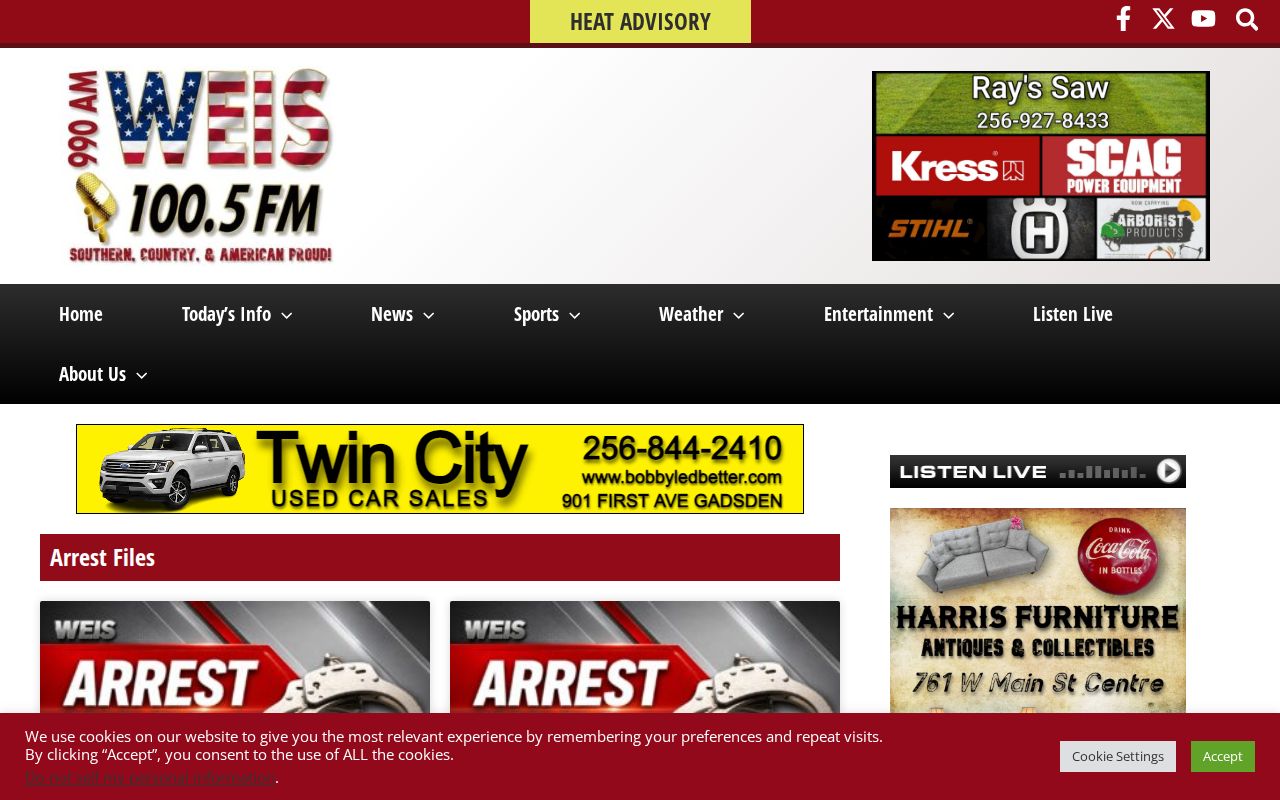
Every headline carries a date. That makes the archive a rough calendar of county arrest reporting on its own.
Inside a post, the entries hold to one shape: a name, an age, a city, the arresting agency, and the charge as reported. The sample post drew entries from more than one agency. That mix is exactly what a county blotter needs, since the sheriff's roster never says who made an arrest. The same post mentioned 84 inmates housed early in the day. Be careful with that figure. It is a point-in-time headcount of the jail, not a tally of that day's bookings, and the two numbers answer different questions. Conflate them and a morning census becomes an arrest count nothing supports. Read the headcount as color, not data.
See the entry format in context in this sample arrest file covering Saturday, May 23.
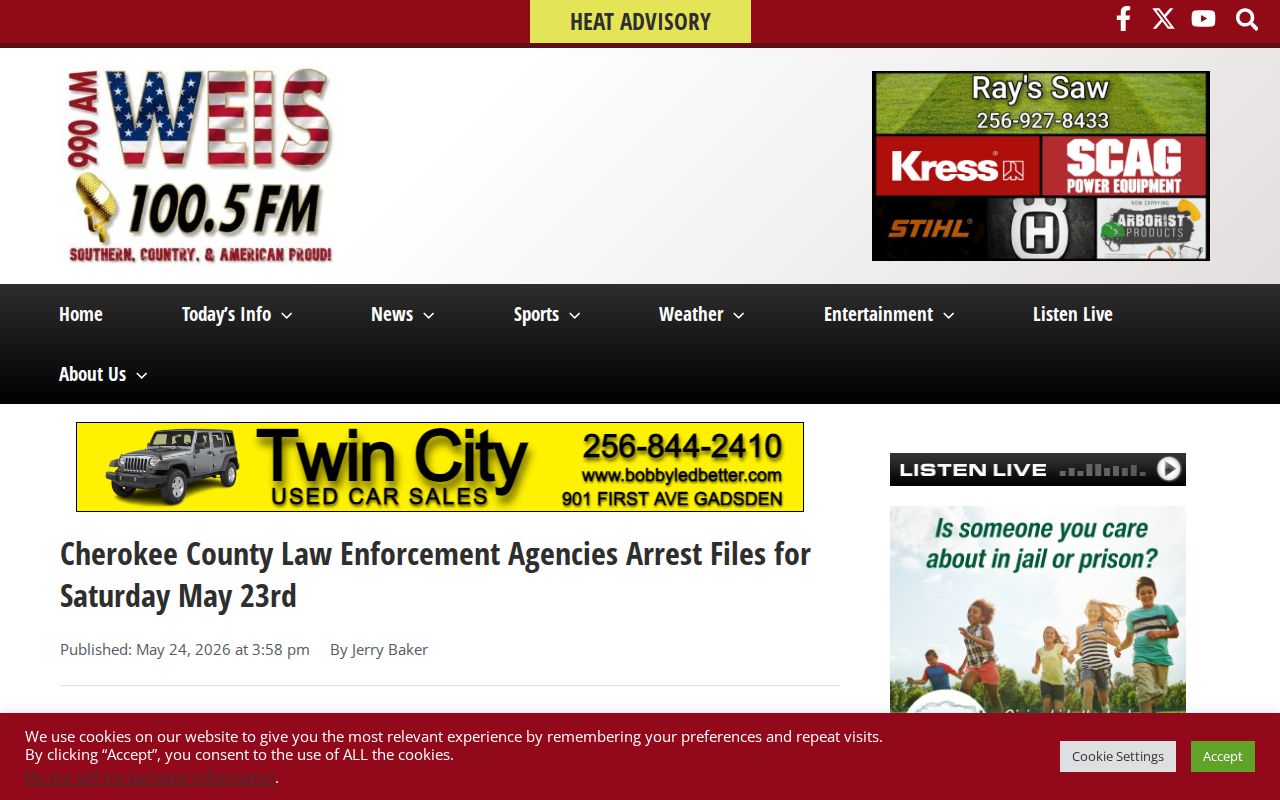
No booking photographs ran with the sampled post. The entries carried no booking numbers either. Anyone trying to confirm an identity should check the official roster.
Note: WEIS is a local radio news service, and its arrest files are journalism, not a certified agency record.
How to Read the Multi-Day Blotter
A news blotter takes more discipline than a roster, because its entries are prose rather than records. Keep the sequence straight in your head. For same-day custody movement, pair the blotter with the 24 hour arrests view. That page handles the official short window.
- Open the arrest-files archive and note the date on the newest post.
- Work backward through the dated posts until you cover the days you care about, using the pagination when the first page runs out.
- Read each entry's agency and city labels closely, since Centre Police, Cedar Bluff Police, Leesburg Police, and the Sheriff's Office all book into the same county jail.
- Match any name that matters against the current roster before assuming the person is still in custody.
- Record the article date and URL for anything you rely on later. News posts outlive roster cards.
Give the city label a second read. Next to a name, it usually means where the person lives. It is not where the arrest happened. It is never who is prosecuting the case.
What an Arrest Log Entry Shows
The news entry trades precision for reach. The table lays out what each field carries and what it leaves out.
| Field | What It Shows |
|---|---|
| Name | The person's name as the outlet reported it from agency information |
| Age | The age supplied with the entry, often the only separator between people with the same name |
| City | The city attached to the entry, frequently a residence rather than an arrest location |
| Arresting agency | The department that made the arrest, a detail the sheriff's roster does not carry |
| Charges as reported | The charge in the outlet's wording, which can differ from the booking card's labels |
The gaps matter most when you compare a news entry with a roster card. The sampled posts carried no booking numbers, so two people with the same name cannot be told apart from the article alone. No booking photographs ran either. Charge wording can drift as well: a news post may spell out what the jail card records as a short abbreviation. Think of the article as locating the event and the roster as confirming the record. A booking card ties the same event to a number, a timestamp, and a charge label the jail itself entered. Use the article to find the day. Use the card to confirm the person. The precision lives in the card.
Weekend and Holiday Arrest Patterns
Arrests happen at all hours. Posting does not. A WEIS article covering Saturday arrests can appear Sunday afternoon, and holidays add their own drag. So expect lag. A Saturday booking might land in a Sunday post, a Monday post, or no post at all if the outlet skips a day. Weekend arrest volume runs high in most counties, and that stretch between event and report gets longer. None of this changes custody. Someone arrested Friday can bond out before the Sunday article goes live, yet the story still reads as fresh a year later. Check the live roster before treating any weekend name as currently held.
Coosa Valley News Arrest Reports
Coosa Valley News offers a second format. Its Cherokee County arrest report covers the previous 24 hours, listing each person's name, age, city, arresting agency, and charges, with no booking-photo gallery. The cadence is intermittent rather than daily, so treat it as a cross-check rather than a schedule. When a WEIS post and a Coosa Valley report cover the same period, comparing them is the cheapest accuracy check available. If the two disagree, go to the roster.
The format is compact, one line per person, as this Coosa Valley News arrest report sample shows.

Both outlets label the material as reporting. Neither claims to be the sheriff's database, and neither should be cited as one. They report arrests. The official roster records them.
Note: Neither local outlet publishes booking numbers, so the official roster remains the only identity check for a common name.
Releases Are Not New Arrests
Two lists, two verbs. The sheriff's released view records departures: people who left the jail inside a short rolling window, some booked days or weeks earlier. The news blotter records reports, descriptions an agency gave an outlet about a prior day. Neither counts bookings. Add them together and you get a number that means nothing. The county publishes no booking tally, so any count of people arrested this week, built from these sources, is an estimate at best.
Keep three states distinct. Just booked, still held, already released. Each state has its own source, and only the live roster answers the custody question. The same discipline applies to weekly and monthly questions. A month of posts is a month of reports, not a month of bookings, and a gap between posts is not a zero-arrest day. A true booking count for any period would take a narrow request to the jail's own records, and the county has published none online. Until then, the honest phrase is arrests reported, never arrests made. That difference matters to everyone named.
Archives and Older Arrest Records
Older reporting survives in the outlet's own archive pages once a post rolls off the first page. Official records live elsewhere, and they outlast the news cycle. The sheriff may hold detention logs, booking cards, and release records reaching beyond what the web roster displays. The arresting municipal department may hold the incident report from the same event. The Circuit Clerk holds the case file, and the Alabama Department of Corrections holds records for anyone who reached state custody. The county records guide maps those channels end to end. No single office answers the others' questions.
How long a record survives is a question of state schedules, not websites. The Alabama Department of Archives and History administers Records Disposition Authorities for local agencies, and the Local Government Records Commission must approve destruction first. No Cherokee-specific retention number is published for booking records. So keep any request narrow: a name, a booking number if known, a date range, the record type, and a preferred format, plus a question about any fee. The sheriff's FAQ routes incident report copies through the office during normal business hours. A record missing from the web is not a record destroyed.