
VINELink Coverage for Cherokee County
The county confirms its own participation. The Cherokee County Detention Center's official page states plainly that the facility takes part in the Vine System, a free and anonymous computer-based service built to give crime victims information and notification. Two doors lead in. One is vinelink.com; the other is the toll-free line 1-877-846-3425. Either way, VINE reports whether an offender sits in the participating jail and fires off automatic calls to a registered number when that person is released, moved, or escapes. That participation is exactly what makes a Cherokee County custody search work instead of stalling out.
Know the edges too. VINE is not a court docket. It is not a prosecutor's file, and it will not show a booking photo. Its whole job is custody answers and notices, both free to anyone who registers.
The anonymity is real but limited. A search starts with a name or an identifier, no account needed. Registration is different. A notice needs a destination, so signing up asks for a phone number or email address. The county's description centers victims of crime and the people close to them, though nothing restricts the service to that group alone.
Entry runs through a state-by-state search application, as the VINELink website displays.

The application is dynamic, and screens can shift. What follows is the general path, not fixed form labels.
How to Check a Person on VINELink
No published list of required fields exists for Cherokee County, so the live prompts decide what gets typed. The flow holds steady regardless: choose a state, choose an agency, run the person search, open the record. For the fuller booking details sitting behind a custody answer, the county arrest record guide lays out the roster and court routes.
- Open VINELink and choose Alabama as the state.
- Select the participating Cherokee County jail when the interface presents its agency choices.
- Search by the person's name or by an identifier the source system accepts, following the live prompts instead of assumed fields.
- Open the matching record and read the custody status it returns.
- Handle multiple matches carefully, comparing any age or identifier shown before treating a result as the right person.
Expect crowds with common names; they return multiple records. VINE results also run thinner than roster cards, because the service answers custody and drives notifications rather than copying the booking sheet.
Note: The county publishes only a phone number and a website for VINE, so the live interface alone defines the search fields.
What a VINELink Result Shows
A VINE result stays narrow by design. The table covers what it delivers and where its borders sit.
| Field | What It Means |
|---|---|
| Custody status | Whether the person is shown in the participating jail at the time of the search |
| Participating facility | The jail or agency whose record the service is reporting |
| Person identifiers | The name and any identifier the source system supplies, used to separate similar people |
| Notification availability | Whether the record supports registration for release, transfer, or escape notices |
Treat the result as one thing: a custody and notification answer. It is not a criminal history. A clean result does not mean a person has no cases, and a hit does not mean a conviction of any kind. When a release or transfer happens, the Cherokee County roster card rolls off as custody ends, and the online result moves with the record behind it.
Status change is the point of the whole system. A registered phone gets an automatic call, and the web result shifts once the participating record moves. Nothing travels instantly, though. A change at the jail reaches VINE only when the jail's own data does. That lag matters, and it comes up again below.
How to Register for Custody Alerts
After a Cherokee County arrest, registration is the half of VINE that counts most. Both entrances stay open: vinelink.com online, or 1-877-846-3425 by phone. Free and anonymous throughout. The federal Office for Victims of Crime lists phone, email, text, and TTY notification options where a state or county supports them, and it urges keeping registration details current. Either route builds the same registration and triggers the same notices. Victims, family members, and anyone else with a stake can use either one. The county's description mentions no fee anywhere.
- Search the person and open the correct record, because registration attaches to a specific custody record.
- Choose the register option on that record.
- Enter the phone number or email address that should receive notices, including a TTY option where the interface supports one.
- Create or safely retain the PIN or credentials the interface issues, since they manage the registration afterward.
- Keep the registration current, updating any number or address that changes, because a notice sent to a dead line is never received.
Guard the PIN. It is the key to reviewing or managing an alert setup later, and it belongs somewhere retrievable rather than remembered only in a panic.
Note: Registration is free and anonymous, but a notice only reaches the phone or email a registrant keeps current.
VINE or Alabama VNS: Which to Use
Alabama runs two separate notification systems. Mixing them up costs you time when news matters most. The Cherokee County Detention Center takes part in VINE, the local jail service covered above. The state's own Victim Notification System, at victims.alabama.gov, serves a different crowd: offenders convicted in Alabama and placed in Department of Corrections custody. Its landing page points people with cases still headed to trial back to the county Sheriff. Users of an older system must re-register there to keep getting notices. So the custody question settles it. Awaiting trial in the county jail? Use VINE. Convicted and sentenced to state prison? The state VNS. A VINELink custody check handles the first case. The second never touches the county roster at all.
The state system states its scope plainly, as the Alabama VNS site shows.
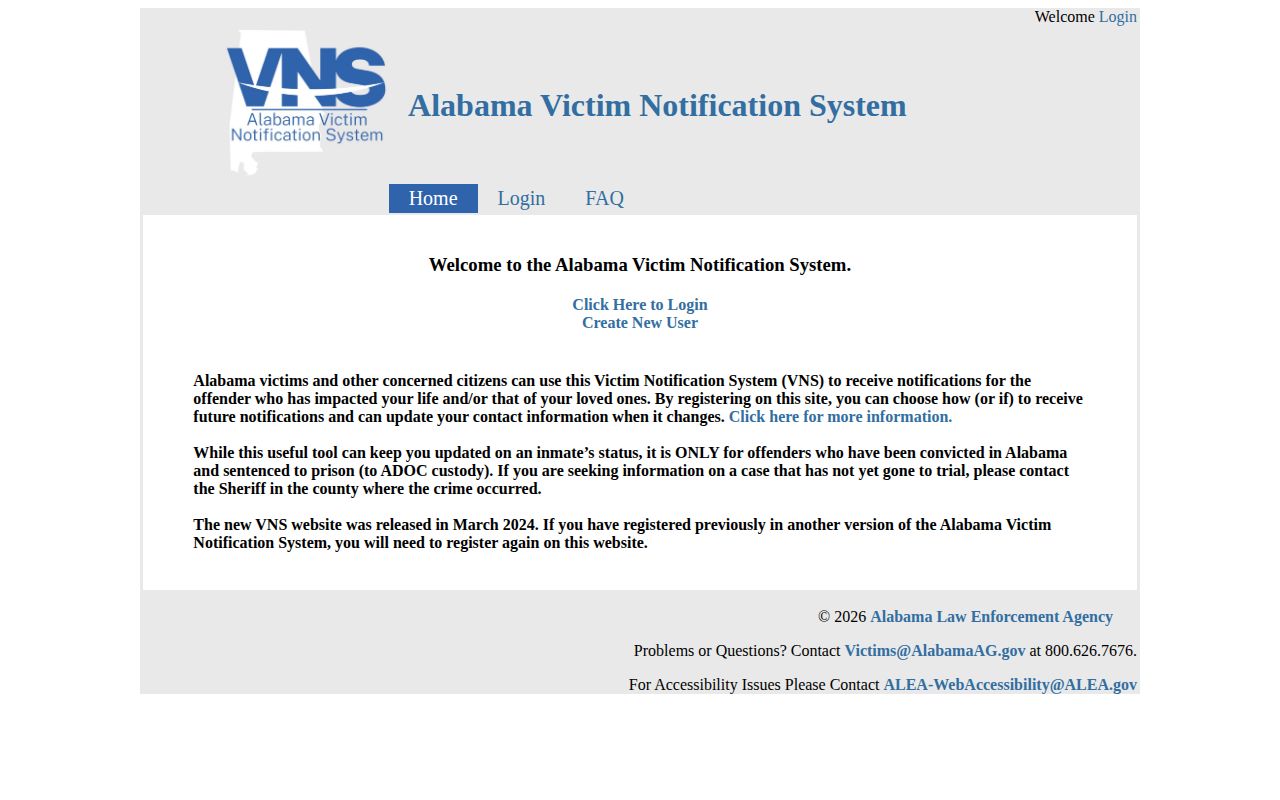
So the split is simple. Right after a Cherokee County arrest, the case is still untried. That is exactly the situation the state page routes back to the county level, and VINE is the tool that fits.
VINELink Limits After a Fresh Arrest
VINE is strong at its job and thin at the edges. A fresh booking has to reach the jail's system first. Until then, no downstream service can see it. A same-day search can come back empty while the person is still in custody. Coverage has limits too. The Office for Victims of Crime describes a wider notification landscape, with separate systems run by the Department of Justice and the Department of Homeland Security, and it treats VINE as the state and local starting point rather than the whole map. No notification service is a safety device. Keep a safety plan and emergency lines separate from any website.
Confirm a same-day arrest directly. New bookings can lag data entry. Check the 24 hour arrests view, or call the detention center at 256-927-6435, rather than trusting one empty search. For immediate safety, never rely on a notification service as your only protection.
The detention center's custody scope adds another edge. It holds people for the county, its municipalities, the state, and the U.S. Marshals Service, so someone can sit in local custody on a matter a county notification flow does not fully describe.
The fix for every limit here is the same. Use VINE for the notice, and the county's own channels for the fact. A roster check shows where a person stands this hour. A call answers what the website cannot. A court record answers what no locator ever will.
County Jail vs State Prison Custody
Every locator answers one slice of custody, and choosing the wrong slice gives you a false negative that looks like an answer. The Cherokee County roster covers the county detention center. The ADOC inmate search covers people in state prison, searchable by AIS number or name, with no booking photos and no historical data online. The federal Bureau of Prisons locator handles federal prisoners from 1982 forward. The ICE detainee locator covers immigration detention. Marshals Service prisoners can also be housed in local jails under contract, which means a federal case can sit behind a county address.
The sequencing question comes up most after sentencing. A person who leaves the Cherokee County Detention Center for state prison drops off the county roster the same week the ADOC entry appears, and families often read that gap as a transfer gone wrong. It is usually just two systems updating on two schedules. Check both before assuming either.
VINELink answers the county slice and registers the alert. For every other custody type, use the system built for it. Treat an absence from one locator as a reason to try the correct one, never as the final word.
Note: No single locator lists every person arrested in Cherokee County, because each one covers a different custody system.