
Cherokee County Recent Arrests
The Cherokee County Sheriff's Office keeps one public roster with two views. One view shows who is in custody right now. The other, labeled 48 Hour Release, lists people recently released from the jail. There is no same-day booking feed and no multi-day blotter on the official side, so a local news arrest file fills that gap. For anyone tracking Cherokee County recent arrests, the roster windows are the place to start.
Three snapshot figures from September 2026 frame the public record.
Each window answers a different question, and mixing them up is the most common mistake when tracking Cherokee County recent arrests.
| Window | Where | What It Covers | Photos? |
|---|---|---|---|
| Current custody | Sheriff current roster (roster.php) | People shown as current inmates at the visit, across county, municipal, state, and U.S. Marshals housing | Yes, when the live record supplies one |
| Same-day-adjacent | Sheriff released view | Recent releases with booking and release timestamps; an older booking can carry a recent release date | Yes, on release cards |
| Multi-day news blotter | WEIS Radio arrest files | Prior-day or prior-period reports naming people, ages, cities, arresting agencies, and charges | No gallery in the sampled reports |
The same-day angle, including where the release view falls short, gets a full walkthrough on the 24 hour arrests page. The multi-day blotter and its news archive sit on the arrest log page. One wording point matters most here. That release view is a rolling display of recent releases, not a literal booking feed covering the last two days. A card can belong to someone booked days earlier whose release just posted now. Count releases as fresh arrests and you misread the page.
Arrested Last Night in Cherokee County
Someone arrested last night in Cherokee County lands in the county detention center. The newest activity hits the current custody roster first. A just-processed booking can lag while intake data gets entered, so an overnight arrest may take time to appear. The 48 Hour Release view shows who just left, pairing each release timestamp with the booking time. For one specific person, VINELink tracks custody and can send a notice for release, transfer, or escape.
Where the record lives depends entirely on custody state.
| Booked vs Released | Where the Record Lives |
|---|---|
| Currently held | On the current roster, with booking number, charges, bond, and photo |
| Released, off the roster | No longer displayed, but the booking record stays obtainable from the Sheriff by request |
| Moved to state prison after sentencing | Findable in the ADOC Inmate Search under an AIS number, while the county card rolls off |
Note: Call the detention center to confirm current custody, since a name can be absent from the roster for ordinary reasons.
How Long Until a Cherokee County Booking Appears?
Every inmate booked at the Cherokee County jail gets published, along with the charge and any bond amount listed, according to the Sheriff's FAQ. Once a booking goes live, the card adds the photo, the booking number, and the exact date and time. No promised interval exists. There is no batch hour, no refresh schedule, nothing official. So when timing matters, call the detention center at 256-927-6435 after checking the roster.
A Cherokee County arrest that never earns a current card usually has a simple cause: a fast release, a transfer, paperwork still moving, or a name spelled differently than searched.
Searching the Cherokee County Jail Roster
Start at the Sheriff's roster selection page, which splits its listings into Current Inmates and 48 Hour Release. The agency posts its own caution right there. The roster is supplied for convenience, it says, and can't be certified as accurate or authentic, so treat a card as a first check rather than a certified record.
The current roster's controls stay simple, and each control does one job.
| Control | What It Does |
|---|---|
| Name | Highlights the name field for searching |
| Date | Sorts entries by date |
| Current | Switches to the current custody view |
| Released | Switches to the 48-hour release view |
| Name box | Accepts a first or last name; the surname works best |
| Search | Runs the name query |
| Show All | Clears the query and lists every entry |
A search takes five steps.
- Choose the view: Current Inmates for someone believed held, 48 Hour Release for recent releases.
- Search the surname in the name box; try a shorter spelling when nothing returns.
- Confirm the booking number and booking date and time on the card, not just the name.
- Read the release timestamp correctly: a released-view card is a release record, not proof of current custody.
- Record the access date and the source URL, because counts and card contents change.
Booking photos appear on the public cards whenever the live record includes one. The Sheriff publishes no separate photo policy for the jail roster, promises no universal availability, and gives no retention period. Entry counts also vary with the day, since the roster reflects who is in custody at that moment rather than capacity or daily booking totals.
To browse the cards yourself, open the Sheriff's current roster, where the controls and any booking photo for each Cherokee County arrest are displayed on the official page.
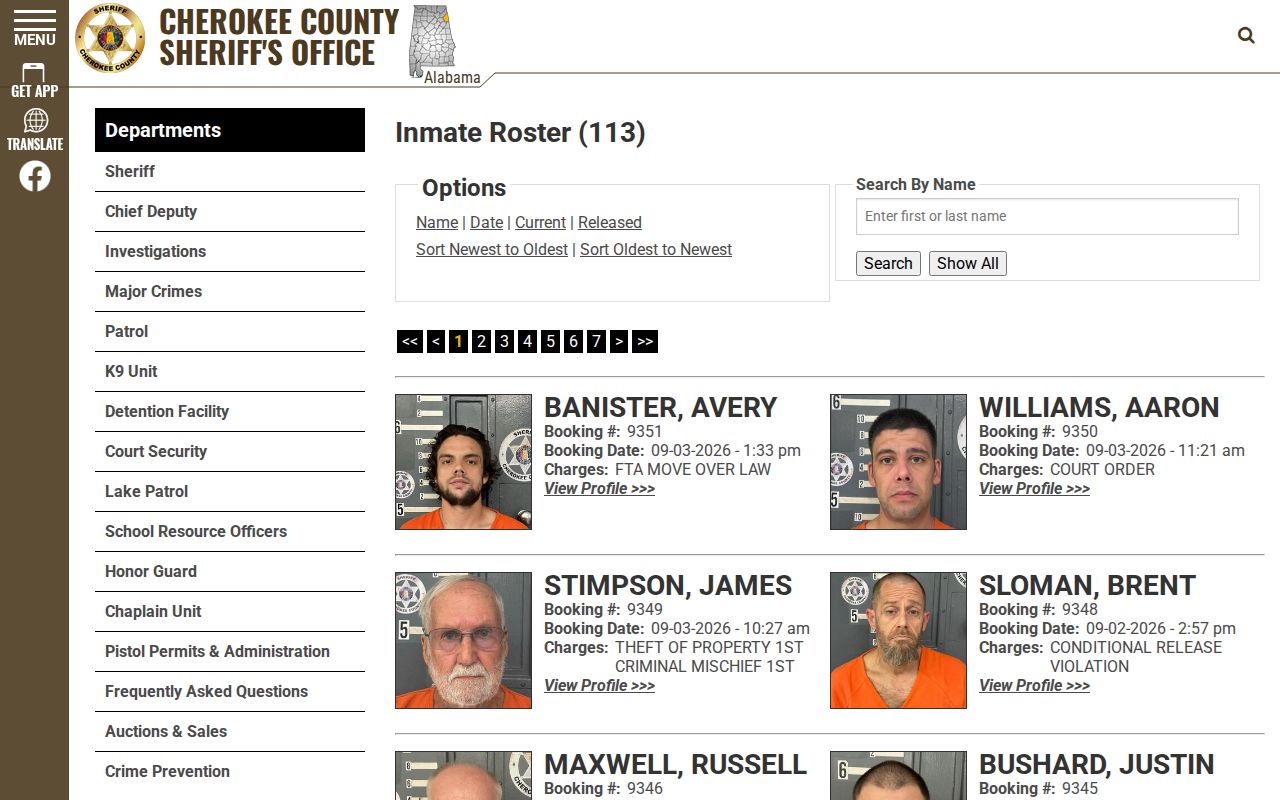
The live roster is the record that counts. Entries move as custody changes, so a name seen this morning may be gone by evening.
Note: The agency's own disclaimer tells readers the display is informal, not a certified record.
Who the Cherokee County Detention Center Holds
Cherokee County opened its detention center in October 1996 and renovated it in 2004. Adults held there come from several sources. The jail houses men and women for the county, for local municipalities, for the state, and for the U.S. Marshals Service. Because of that mix, a single roster card can't tell you which authority holds the person or where the case sits.
Bond options at the facility are spelled out clearly. The jail accepts property bonds with two signatures and qualifying property, cash bonds through the Circuit Clerk or Cash Bond Online, and bonds from licensed companies. Bonding runs seven days a week, with three daily breaks: 5 to 7 a.m., 11 a.m. to 1 p.m., and 5 to 7 p.m. A zero bond on a card can mean a court order from the presiding judge is needed, or that fines must be paid through the Circuit Clerk. Even then, no release time is promised. Posting a bond starts a process, not a countdown.
The full housing scope, bond rules, and VINE participation details sit on the official detention facility page.
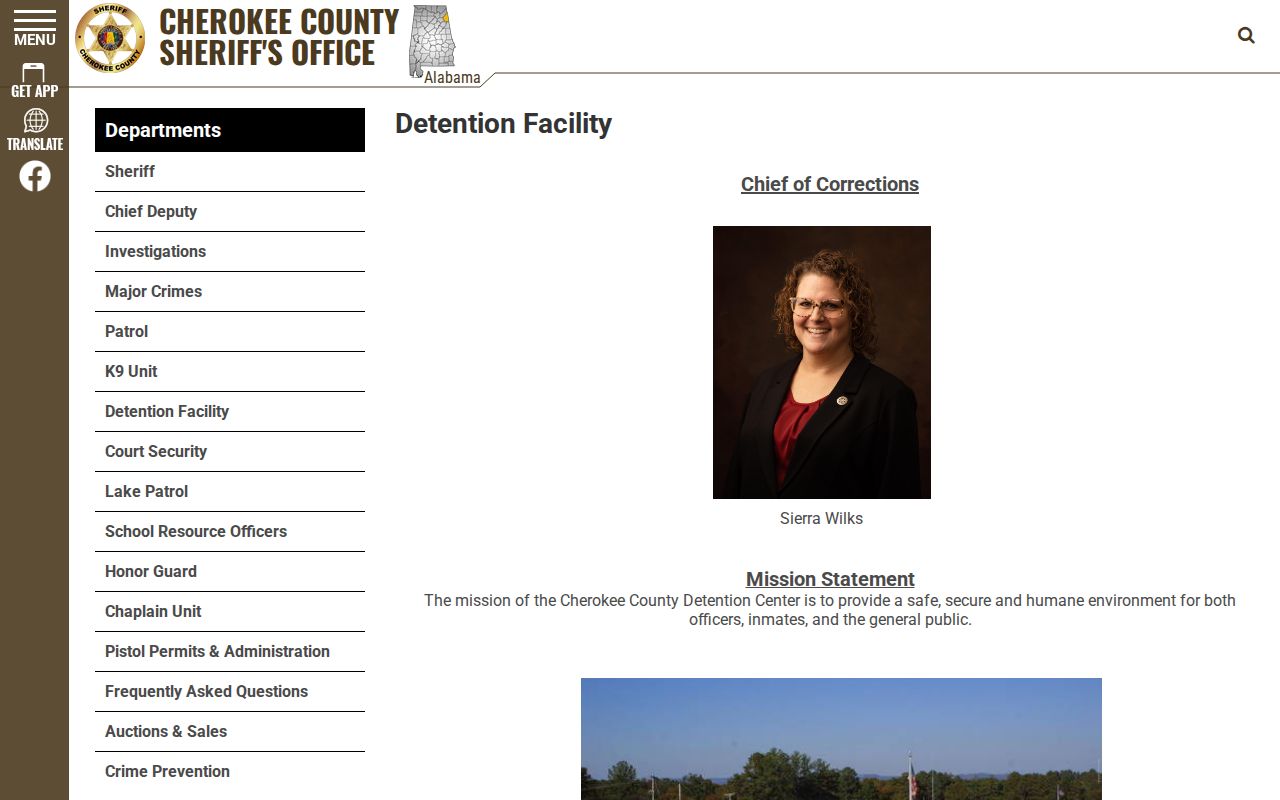
The detention page is also the controlling source for VINE participation.
Where Cherokee County Arrests Are Published
Cherokee County arrests surface in three layers. Official channels come first, led by the county roster and its release view. Local news sits second. WEIS Radio files arrest reports that name the arresting agency, distinguishing Centre Police, Leesburg Police, and Sheriff entries. Coosa Valley News posts a previous-24-hours report on a looser schedule. Neither outlet is a custody database, though, and neither publishes booking photos. Third-party aggregators round out the mix, and they carry their own risks.
| Channel | Photos? | Official? | How to Access |
|---|---|---|---|
| Current custody roster | Yes, on cards | Yes | Sheriff roster at roster.php |
| 48 Hour Release view | Yes, on cards | Yes | The released view linked above |
| Cherokee Sheriff AL app | Roster-linked, no separate feed | Yes | Sheriff app page and app stores |
| Sheriff alerts signup | No | Yes, agency publication alerts | SMS or email signup on the Sheriff site |
| WEIS Radio arrest files | No | Local news | Arrest-files archive, paginated |
| Coosa Valley News | No | Local news, intermittent | Prior-24-hours Cherokee arrest reports |
| Busted Newspaper | Yes, third-party | No, unofficial | County section, deep history |
| RecentlyBooked | Yes, third-party | No, unofficial | County section, multiple daily refreshes |
| Arrests.org | Yes, third-party | No, unofficial | County section with filters |
| Mugshots.zone | Yes, third-party | No, unofficial | County mirror with agency codes |
Treat the unofficial sites with caution. Any of them can sit stale, drop names, mislabel a county, or trail far behind who is actually in custody. None of them holds the booking record itself. Before you rely on a third-party page for a Cherokee County arrest, check the name against the official roster or the court file.
One example of that format is RecentlyBooked's Cherokee County section.
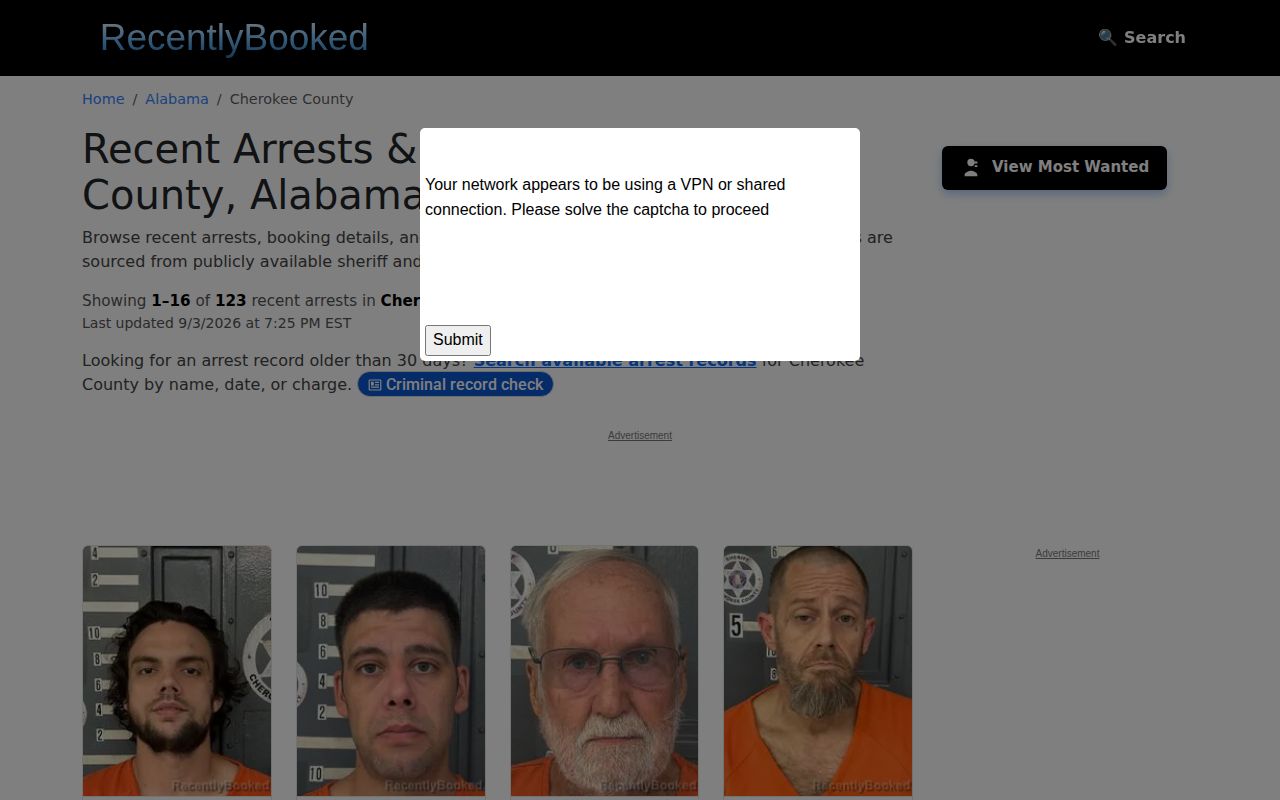
The RecentlyBooked page is a copy, not a live custody check. A detail page there can linger online long after the official card is gone.
Note: An aggregator listing can outlast a release, dismissal, or expungement that changes the official record.
The Cherokee Sheriff AL App and Alerts
The Sheriff's free Cherokee Sheriff AL app arrived on June 3, 2019, in Google Play and the Apple App Store. Its launch press release lists Contact Us links, crime tips, the Inmate Roster, Most Wanted, a sex-offender map, press releases, and push notifications you can tailor. Download images sit on the app page. Think of the app as a doorway to the same website tools rather than a separate booking database. The roster it links to remains the photo-bearing source.
A separate alerts signup sends SMS and email notices whenever the Sheriff site publishes something new. Those alerts track agency publications, not VINE, and no booking is promised a message. For custody notice on one person, VINE is the right channel.
Recent Arrests by City in Cherokee County
Every incorporated place in Cherokee County books into the same detention center. City arrest coverage therefore flows through the county roster. Each of the three largest cities gets its own page here, collecting the local angle: the police department and the path a booking takes.
- Centre Recent Arrests: the county seat, served by the Centre Police Department; city arrestees booked at the county detention center appear on the county roster.
- Cedar Bluff Recent Arrests: served by the Cedar Bluff Police Department. The town publishes monthly police activity totals in council minutes rather than a daily blotter.
- Leesburg Recent Arrests: served by the Town of Leesburg Police, part of the multi-agency Major Crimes Unit alongside the Sheriff, the District Attorney, Centre Police, and Cedar Bluff Police.
What a Cherokee County Arrest Record Shows
A Cherokee County arrest record is a time-stamped snapshot built at intake by the receiving facility. The booking time marks when the detention center processed the person, not when an officer made the stop. So a municipal arrest and a county booking are connected but distinct events. Charges on the card are labels typed in at intake, not prosecutor filings.
The public card sticks to a consistent set of fields.
| Field | What It Shows |
|---|---|
| Name | Displayed surname and given name, often uppercase; check spelling against the profile |
| Booking number | Numeric identifier for one booking; the best locator for a records request |
| Booking date and time | The intake timestamp set by the facility |
| Charges | The charge labels or abbreviations entered at booking |
| Bond | Any bond amount available when the entry was published |
| Booking photograph | Photo displayed when the live record supplies one |
| Release date and time | Shown on the released view, separate from the booking timestamp |
| Profile link | A View Profile link to the individual entry |
The detention page includes a key for local shorthand. TOP, UPODP, UPOM, UMOCS, UPOCS, UDOCS, FTA and FTP, DUI, VPL, and GJI all appear there. Read them only as the key defines them, never as the charge a court eventually weighs.
- Booking
- Intake processing at the jail, which creates the custody record.
- Bond
- An amount or security set for pretrial release; posting it does not resolve the charge.
- Arraignment
- An early hearing where the charge is addressed and a plea may be entered.
- Disposition
- The final outcome of a case, such as a dismissal, a plea, an acquittal, or a sentence.
- Expungement
- A court-ordered removal of a qualifying record under Alabama's expungement law.
Cherokee County Mugshots and Booking Photos
Cherokee County mugshots live in one official place: the public roster. Photos appear on current and release cards whenever the live record supplies one. The Sheriff publishes no separate policy on retention or reuse. The ADOC Inmate Search has no booking-photo field, so a state custody result shows no county photo; any image belongs to the county card.
Wanting a copy means going through the Sheriff's Office with the booking number and date. No fee, form, or turnaround time is published, so ask the office directly about cost, format, and redaction rules. Aggregator photo pages can sit untouched long after the official card rolls off the roster.
Note: No official source promises a booking photo stays online after a release, transfer, or roster refresh.
How to Obtain a Cherokee County Arrest Record
Start by knowing which record you want. The options sit with different custodians, so a vague ask wastes time. Alabama law gives residents a general right to inspect and copy public records. A narrow request naming one booking always beats a broad one.
- Identify the person precisely, with the booking number and booking date if known.
- Decide the record type: booking card, jail log, intake record, booking photograph, release record, or incident or offense report.
- Put the request in writing to the Sheriff's Office; the FAQ says incident and offense report copies are available there during normal business hours.
- Cite the right to inspect and copy public records under Alabama Code §36-12-40, and follow the request procedures of §36-12-45.
- Ask about the fee, redaction, format, and estimate. None is published for Sheriff records; ADOC, by contrast, publishes a $20 processing fee on its Form 23-A for its own records.
Corrections work from the source outward. Spotted an error on a card? Contact the Sheriff with the booking number, the mistake, and any supporting court order. Expungement stays court-controlled: the state's explanation directs a petitioner to obtain a certified criminal-history record and file the AOC's CR-65 Petition for Expungement, with categories and waiting periods set by Chapter 15-27. A court order does not reach third-party copies on its own. Busted Newspaper offers a free remove-a-listing form that its page says takes 5 to 10 days with documentation; the other aggregators publish no free opt-out. Never pay a removal service to clear a listing, since that demand is the scam. After a source changes, Google's Refresh outdated content tool updates search results, but only once the source itself has changed.
Alabama Arrest Record Laws and Removal
Three statutes frame access and removal in Alabama.
Alabama Code §36-12-40 gives Alabama residents the general right to inspect and copy public records, subject to express exceptions. Agencies get more room under Alabama Code §36-12-45, which lets them set written procedures, charge fees, and refuse requests that are vague, overbroad, or aimed at non-public material. Alabama Code §41-9-625 covers biometric identifiers such as fingerprints and photographs, and it carries disposition-reporting and removal language for people released without charge or cleared. The legislative site flags a 2026 amendment to that section, so confirm the current text before relying on it.
Alabama has never passed a pay-to-remove law. A bill floated in 2014 died in the legislature, so it counts for nothing today. On retention, Cherokee County follows no special number of its own. Local records live and die under Records Disposition Authorities from the Local Government Records Commission and the Alabama Department of Archives and History, and nothing gets destroyed outside that approved channel. So an old arrest record rarely disappears outright. Instead it scatters, turning up in sheriff detention logs, municipal incident reports, Circuit Clerk court files, ADOC holdings, or the state archives.
For expungement, the state publishes its full explanation, including the certified-record prerequisite, at ALEA's criminal record expungement page.
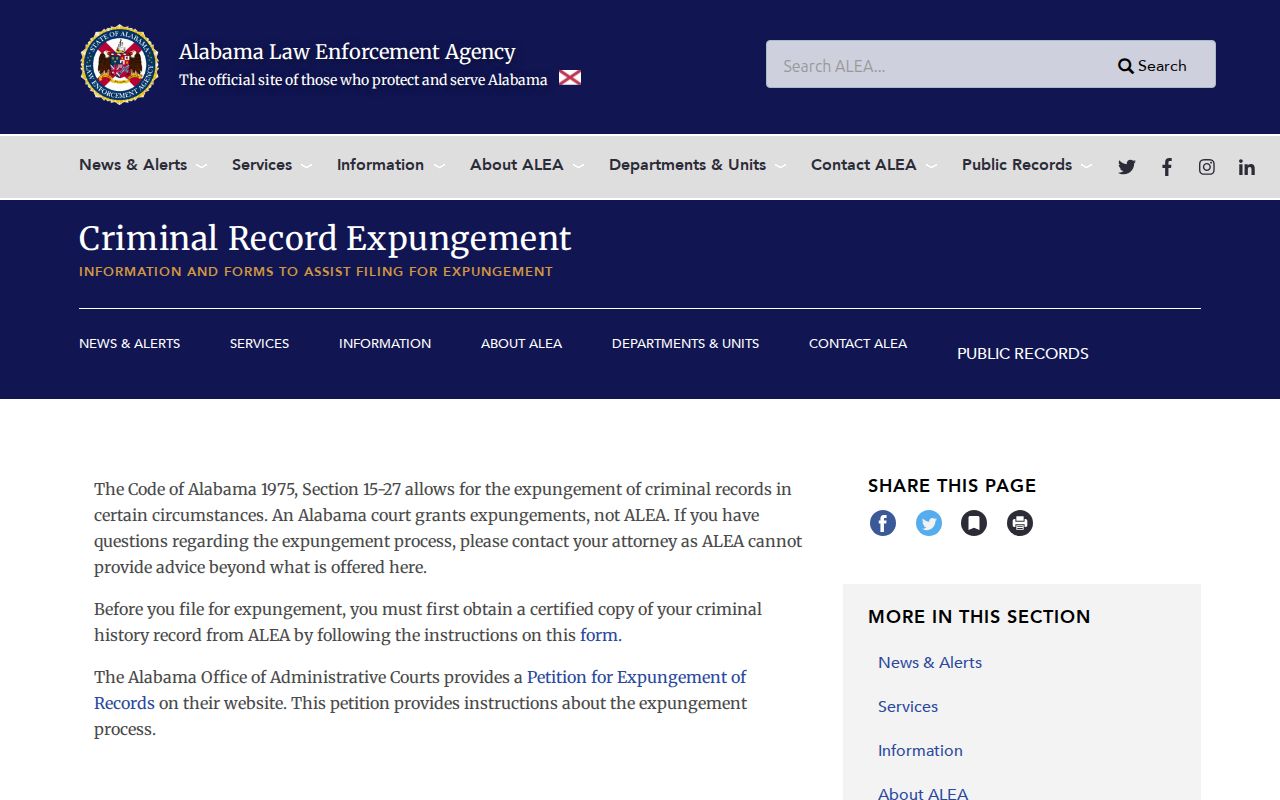
ALEA explains the process, but only a court can grant the order.
Warrants and the Cherokee County Most Wanted List
Cherokee County publishes no public portal for searching warrants by name. Warrants come through the Circuit Clerk, and the paperwork begins with an incident or offense report. Felonies bring investigator assistance. The court's magistrates guidance also handles misdemeanors outside Centre and Cedar Bluff, plus traffic offenses written by State Troopers, county deputies, and Leesburg Police. Anyone who suspects a warrant exists should call the Circuit Clerk, the issuing court, or an attorney.
The Most Wanted list is its own publication, separate from any booking roster. It recently carried four names with sort controls, and it credits tips with 285 arrests since January 11, 2010. Tips go to 256-927-9999. Never approach or confront a listed person. Report what you know and let officers handle the rest.
A disclaimer step comes first, then the official list at the Sheriff's Most Wanted page.
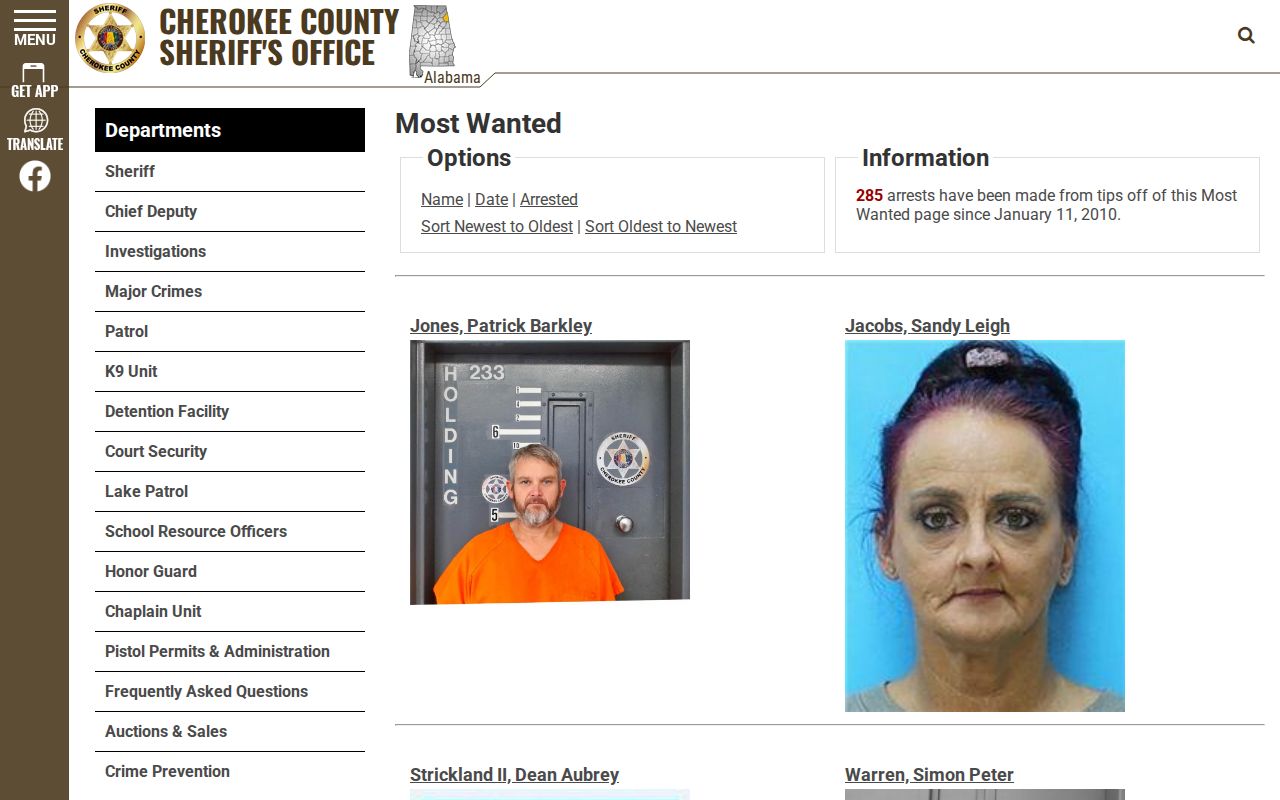
This wanted page is not a booking roster. Each entry is a fugitive listing, not a card for someone currently in custody.
Note: A most-wanted entry can stay online after an arrest until the agency refreshes the page.
After the Arrest: Court Dates and Dispositions
A booking puts a name on the custody roster. What happens next lives on the court docket. Once Cherokee County processes an arrest, the case heads to the Circuit Clerk, whose divisions handle criminal, traffic, juvenile, and warrant matters. The office sits at 373 East Main Street, Suite 102, Centre, and answers at 256-927-3637. Alabama's docket search lets you narrow by Cherokee location and last name. For most trial-court information, the Clerk points to Just One Look, where fees apply. A case missing from a search does not mean it was dismissed; call the Clerk before assuming anything.
One more wrinkle worth knowing. The charge written at booking can be amended, dismissed, nolle prossed, reduced, or resolved by a plea, while the booking card keeps its original labels the whole time. The custody record and the court record simply tell different halves of the story.
The court disposition is where the story finishes. The booking card only records what happened at intake.
Question: The roster still shows a charge that was dismissed. Which record controls?
The court docket wins. A jail roster simply keeps the booking label it was given at intake, and it does not catch up on its own. If a case was dropped, the dismissal lives in the court file, not in the arrest record. Get a certified copy of the order from the Circuit Clerk, then hand one to the Sheriff's Office so the roster can be corrected. Names and filing routes for each division are listed on the Cherokee County Circuit Clerk site.
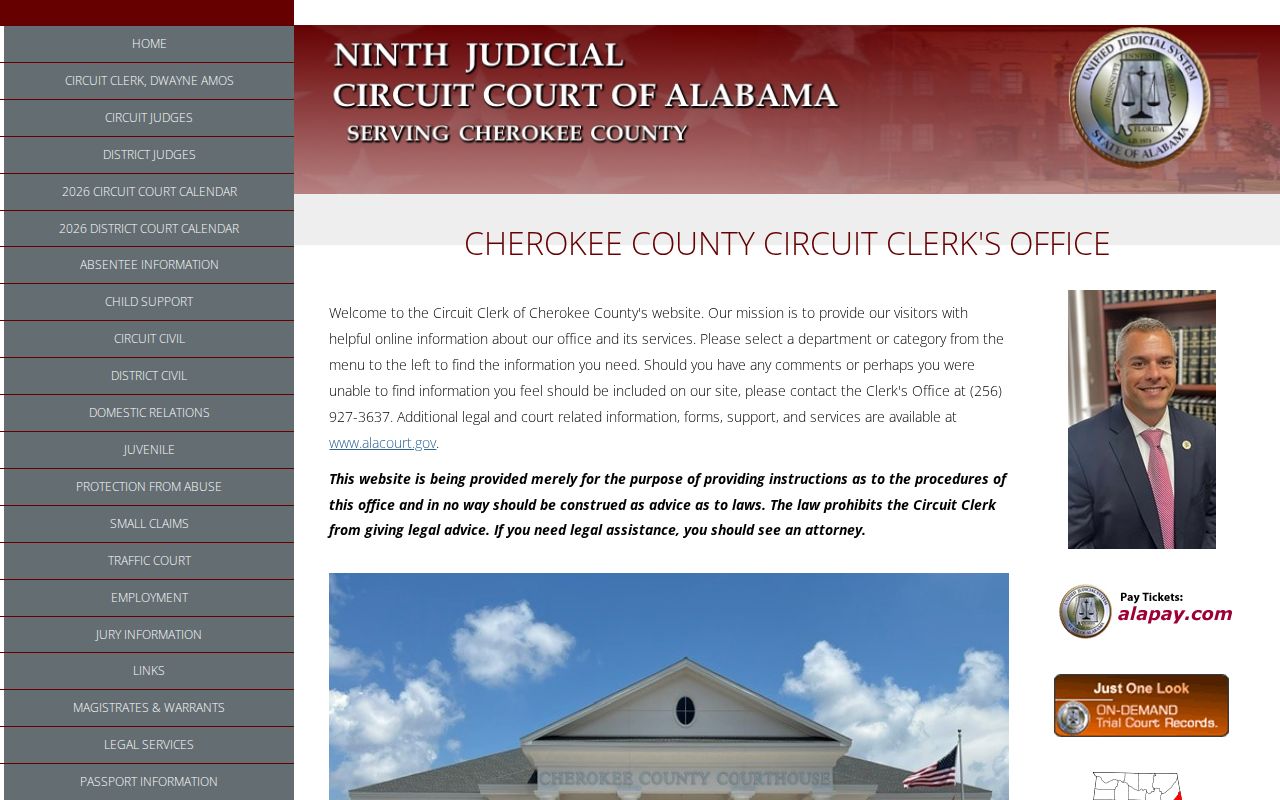
The Clerk keeps the case file the roster never shows.
Centre Municipal Court vs Cherokee County Court
Centre operates its own municipal court, with the courtroom at 999 West Main and the magistrate office at 1111 West Main. That court handles traffic, non-traffic misdemeanors, and city-ordinance cases inside the city and its police jurisdiction. County District and Circuit matters take a different path through the Circuit Clerk. The split causes a familiar confusion: a Centre arrest may not show up where you expect in a state trial-court search, because the case lives in municipal court. Keep the two records straight. A municipal court result is the city case; a county jail booking is the custody event.
State Prison and Federal Custody After an Arrest
A stay in the Cherokee County jail is just the first stop for some people who are arrested. Once a person is moved into state prison, the ADOC Inmate Search becomes the tool to use. It works with a six-digit AIS number, which is the quickest way to pull up a record. The state system only shows current custody. Old records are not online, and there is no booking-photo field at all. Anyone wanting state history must mail Form 23-A and pay the published $20 processing fee.
Federal custody runs on a separate track. The detention center holds U.S. Marshals Service detainees, so those questions go to federal channels. The BOP locator reaches back to 1982, though it carries no county booking photos. Immigration questions go to the ICE Online Detainee Locator, while the Marshals' prisoner information page handles federal detention. Keep in mind that none of these lists, county, state, or federal, captures everyone arrested in Cherokee County. For where booking photos actually sit, see the booking photo section.
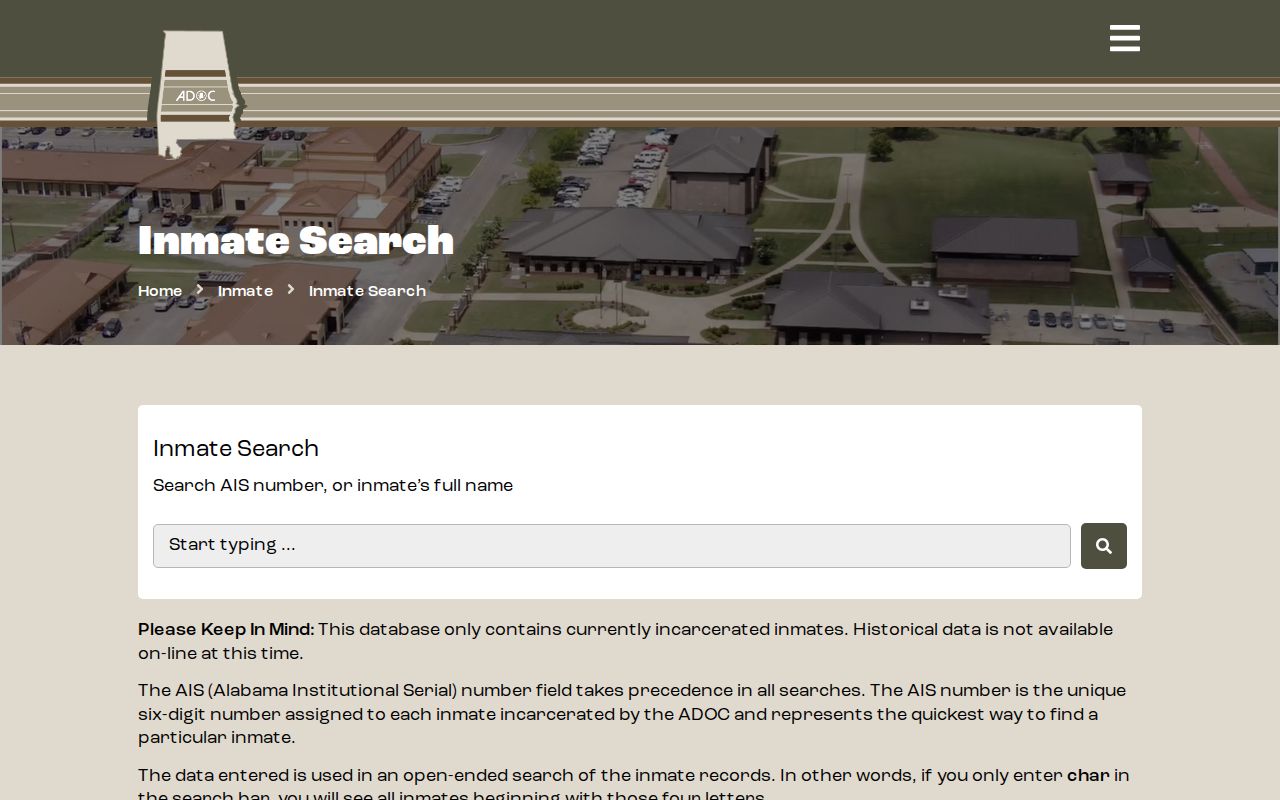
An ADOC hit means the person is in state custody now. It does not trace back to the original county arrest booking.